
Plant-Based vs. Vegan: The Distinction That Actually Matters
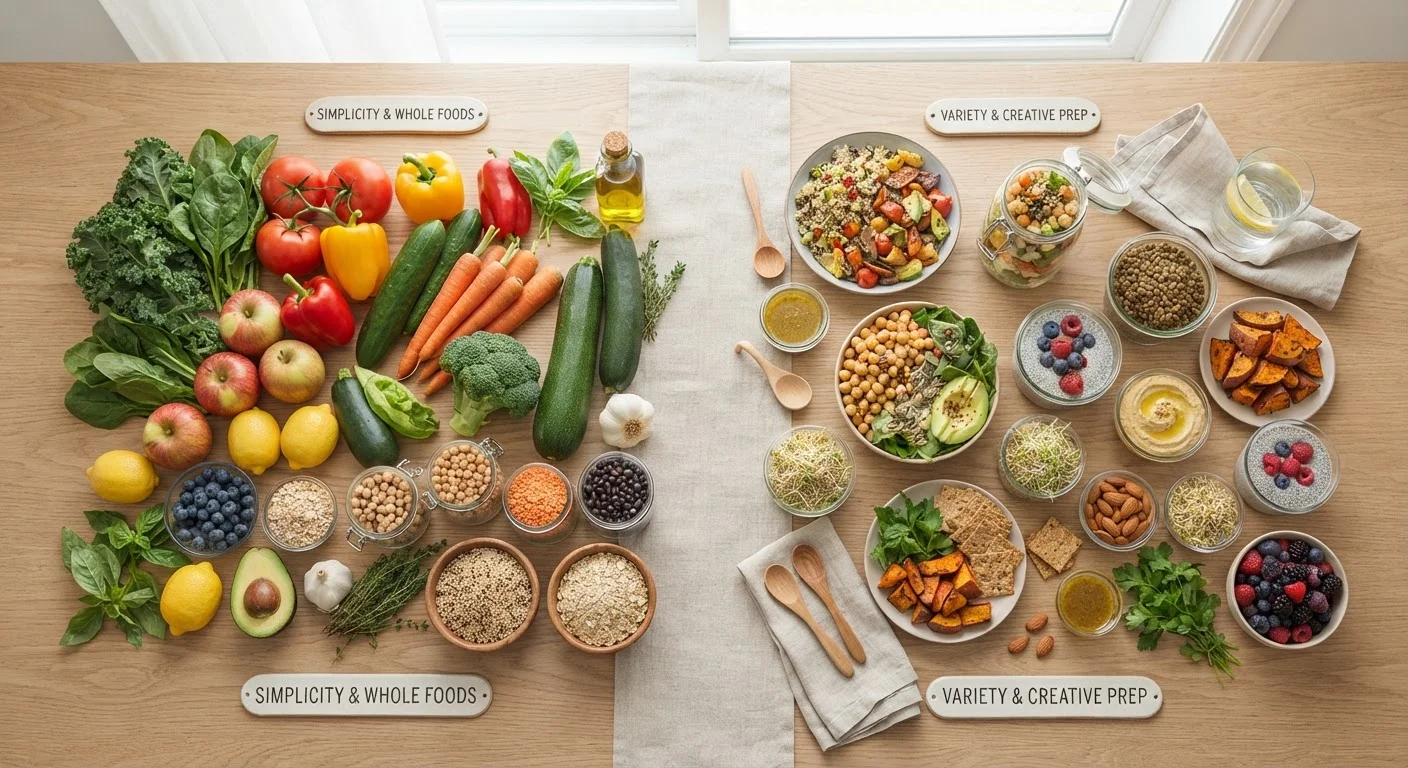
Photo credit: PrimeReads.net | Discover Insightful And Creative Blogs
In this article
Plant-based and vegan are often used interchangeably, but they describe different things. Here's how the two approaches differ in practice.
Key Takeaways
- Plant-based is a dietary descriptor focused on food composition; veganism is an ethical philosophy that shapes all consumer choices.
- A vegan diet excludes all animal products, but the food chosen can still be heavily processed and nutritionally poor.
- Plant-based eating often implies whole, minimally processed foods but doesn't necessarily exclude animal products entirely.
- Someone can be vegan without eating plant-based, and plant-based without being fully vegan.
- Understanding the distinction helps readers choose the framework that best aligns with their actual goals.
Why the Confusion Exists - and Why It Matters
Walk through any grocery store and you'll see "plant-based" and "vegan" used almost interchangeably on packaging, menus, and media. While the two concepts overlap considerably, treating them as synonyms obscures a meaningful difference - one that matters depending on whether your goals are primarily about health, ethics, or both.
The conflation isn't accidental. As plant-forward eating has grown in popularity, food marketers have borrowed terminology freely, often stripping it of its original context. "Vegan" carries strong ethical connotations that some consumers find off-putting; "plant-based" sounds accessible and health-forward. The result is that both terms now appear on products ranging from lentil soup to highly processed meat analogues - without much consistency.
Understanding what each term actually means allows you to choose a framework that genuinely aligns with your goals, rather than one that just fits a label you've seen on a package. See also our look at how gluten-free eating differs between choice and medical necessity for a similar case of a dietary term carrying very different meanings depending on context.
| Criterion | Plant-Based Eating | Veganism |
|---|---|---|
| Primary motivation | Health and nutrition | Ethics and animal welfare |
| Animal products allowed? | Sometimes, in small amounts | No - fully excluded |
| Extends beyond food? | No | Yes - clothing, cosmetics, etc. |
| Processed foods permitted? | Discouraged in strict versions | Permitted if animal-free |
| Defined by a formal organization? | No formal governing body | Yes - The Vegan Society (1944) |
| Flexibility | High - spectrum of adherence | Low - binary animal-free standard |
| Focus on food quality? | Central to the concept | Not inherent to the definition |
What "Vegan" Actually Means
Veganism was defined by The Vegan Society - the organization that coined the term in 1944 - as a philosophy and way of living that seeks to exclude, as far as possible and practicable, all forms of exploitation of animals for food, clothing, or any other purpose. That scope is important: it is explicitly not just a diet.
A vegan diet excludes all animal-derived foods: meat, poultry, fish, dairy, eggs, and honey, as well as less obvious ingredients like gelatin, casein, and certain food colorings derived from insects. But veganism also extends to non-food choices - leather goods, wool, cosmetics tested on animals, and products containing animal byproducts.
Crucially, vegan food can be highly processed and nutritionally incomplete. Vegan cookies, chips, and meat analogues exist in abundance. A diet built around such foods may satisfy the ethical definition of veganism while falling short of what most nutrition researchers would consider a health-promoting dietary pattern. This is a critical distinction that gets lost when the terms are used interchangeably.
What "Plant-Based" Actually Means
"Plant-based" originated in nutrition science - specifically in research communities studying the health effects of diets built primarily around vegetables, fruits, whole grains, legumes, nuts, and seeds. In that context, it describes a dietary pattern, not an ethical stance.
In its most rigorous form - the whole-food plant-based (WFPB) diet - it emphasizes minimally processed plant foods and actively avoids refined grains, added sugars, and oils, regardless of whether those ingredients are animal-derived. You can read a full breakdown in our explainer on the WFPB framework.
Importantly, plant-based eating does not always mean 100% animal-free. Many clinicians and researchers use it to describe diets where plant foods are dominant - but where small amounts of animal products may still appear. A person eating mostly vegetables, legumes, and grains with occasional fish or eggs might reasonably call their diet plant-based. That same person would not meet the definition of vegan.
For those who want a more flexible version of this approach, flexitarianism offers a semi-plant-based framework that reduces rather than eliminates animal foods - a useful middle ground explored in its own right.
Where They Overlap - and Where They Diverge
The overlap is real and substantial. Both approaches result in diets rich in vegetables, legumes, and whole grains, which are consistently associated with health benefits in the nutritional literature, including reduced risk of cardiovascular disease and type 2 diabetes, according to research published in journals such as The Lancet and the American Journal of Clinical Nutrition.
But the divergences are equally real. A vegan who lives primarily on processed vegan foods is ethically consistent but may not be eating in a way that aligns with public health recommendations. Conversely, a person following a strict WFPB diet who occasionally includes a small amount of salmon or yogurt is eating in a nutritionally thoughtful way - but would not qualify as vegan.
~3%
US adults identifying as vegan
Gallup polling has consistently placed the share of self-identified vegans in the US at roughly 3%, while plant-forward eating more broadly has grown substantially.
20%+
Reduction in cardiovascular risk
Research in the American Journal of Clinical Nutrition has found that well-planned plant-predominant diets are associated with meaningfully reduced cardiovascular disease risk compared to typical Western diets.
30-40%
Of vegan packaged foods are ultra-processed
Studies examining vegan food product databases have found a substantial proportion of items fall into ultra-processed categories by NOVA classification, underscoring that vegan does not equal nutritious.
The language around protein is also worth examining here. Both patterns can meet protein needs when planned thoughtfully, though this requires understanding which plant sources contribute most effectively. Our piece on protein myths addresses several persistent misconceptions about plant protein that are relevant to both approaches.
For a broader look at how different eating styles affect vegetable consumption in practice, the comparison of vegetable intake across eating patterns offers useful perspective.
A Note on Individual Nutritional Needs
Both plant-based and vegan dietary patterns can support good health when well planned, but both carry potential nutrient gaps - most notably vitamin B12, vitamin D, calcium, iron, and omega-3 fatty acids. These risks are particularly relevant for vegans, since B12 is not reliably found in plant foods. Anyone making a significant dietary shift should consult a registered dietitian to assess their individual needs. This article provides general educational information and is not a substitute for personalized nutrition guidance.

Author
Food Editorial Team
Food Editorial Team is the collective byline for our editorial team and contributor network. Articles published under this byline or an editorial pen name are researched, written, and reviewed according to our editorial standards for clarity, consistency, and independence before publication.
View all articles →