
Digital vs. Paper: Which Household Management System Actually Works?
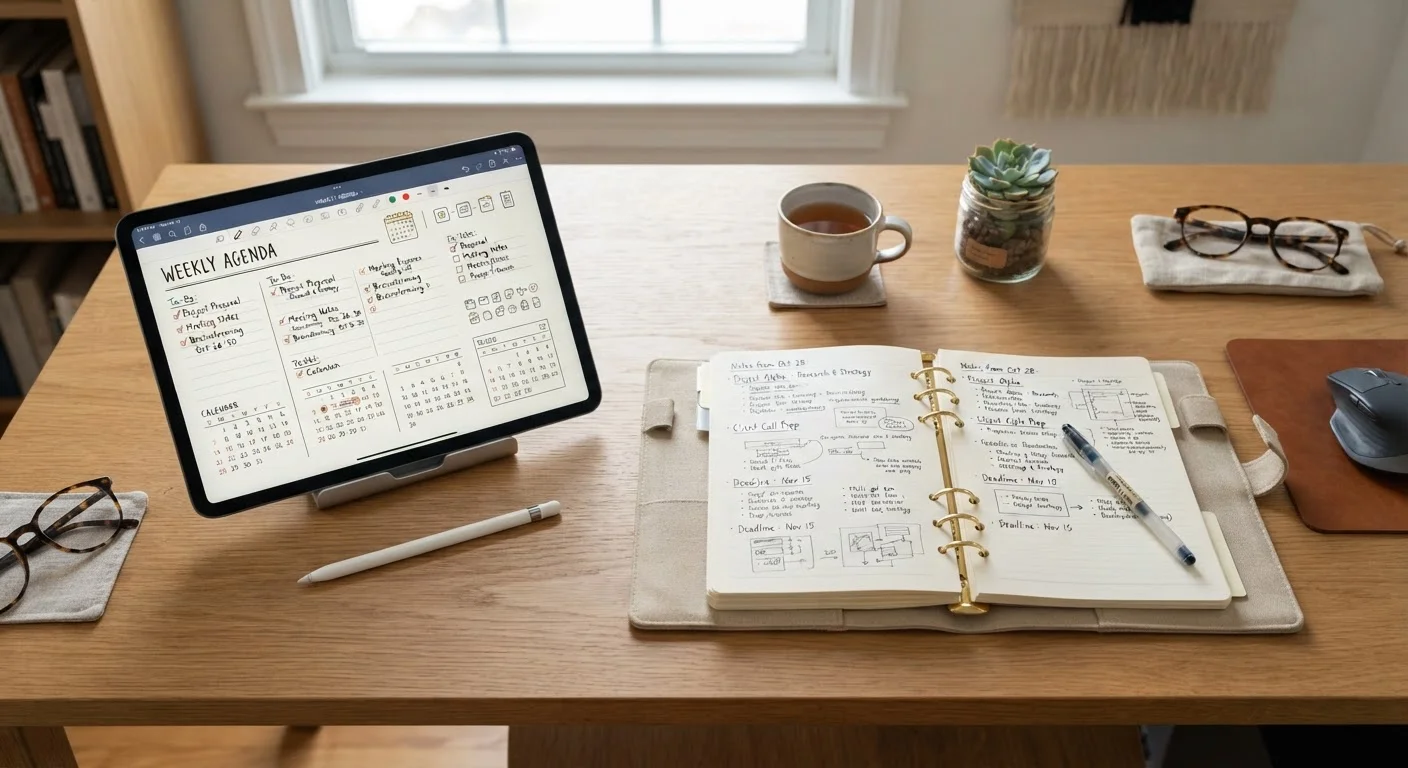
Photo credit: PrimeReads.net | Discover Insightful And Creative Blogs
In this article
Weighing up digital apps against paper planners and binders for managing household tasks, schedules, and documents.
Key Takeaways
- Digital systems excel at sharing information across a household in real time, reducing miscommunication.
- Paper-based systems have no learning curve, no battery life, and no subscription fees.
- The best system is the one your whole household will actually use consistently.
- Hybrid approaches - combining both methods - work well for many families.
- Neither system eliminates the mental load; both require deliberate setup and maintenance.
What Each System Actually Involves
Before comparing them, it helps to define what each approach looks like in practice - not in the abstract, but as a real household tool.
Digital household management typically means using a combination of shared calendar apps, task managers, note-taking tools, and cloud storage to coordinate schedules, track recurring chores, store important documents, and manage household finances. Many households use a mix of apps rather than a single platform.
Paper-based household management ranges from a dedicated family command center on the wall - think calendar, whiteboard, and mail sorter - to a structured home management binder holding everything from appliance manuals to weekly meal plans. Some households use a simple planner or notebook. The format is flexible, but the core idea is the same: physical, tangible records.
Both systems address the same underlying challenge: the invisible but exhausting mental load of running a home. As our guide to managing the household mental load explains, externalizing that load - getting it out of your head and into a system - is the first step toward sharing it more fairly.
| Criterion | Digital Management | Paper-Based Management |
|---|---|---|
| Shared household access | Real-time, any device | Requires physical presence |
| Setup effort | Moderate - accounts, apps, learning curve | Low - buy a binder and start |
| Cost | Free to subscription-based | Low one-time cost |
| Document retrieval | Searchable and fast | Manual, depends on filing system |
| Reliability (no tech needed) | Requires power and internet | Works anywhere, anytime |
| Distraction risk | Higher - notifications, app switching | Lower - single-purpose tool |
| Backup and loss protection | Cloud backup available | Vulnerable to physical damage |
Where Each System Has a Real Advantage
Digital systems win on accessibility and collaboration. A shared app means your partner can check what's needed at the grocery store while you're at work, or mark a chore complete without tracking you down. Changes are immediate and visible to everyone. For households juggling multiple people's schedules, this is genuinely hard to replicate on paper. If you're working through how to build systems that work for the whole household, our article on organizing a home with multiple people covers the group dynamics in detail.
Paper systems win on focus and permanence. There's no notification pulling you away when you open a binder. Paper doesn't get hacked, require a password reset, or disappear when a company shuts down its app. For people who find screens mentally taxing - or who simply trust a physical record more - paper delivers a reliability that no app fully replicates.
Digital systems handle documents better. Searching a PDF for your home warranty beats leafing through a filing cabinet. Cloud backups protect against loss in ways a physical folder cannot.
Paper is better for visual thinkers who need spatial context. A wall calendar gives the whole month at a glance in a way that most apps - optimized for small screens - don't match intuitively.
77%
Adults who own a smartphone in the US
According to Pew Research Center data, smartphone ownership among US adults has grown substantially, making digital tools broadly accessible to most households.
~20 min
Average time lost searching for misplaced items daily
Various productivity researchers estimate that disorganization costs households meaningful time each day, regardless of whether they use digital or paper systems.
2-3x
Better recall with handwritten vs. typed notes
Studies published in cognitive psychology journals suggest handwriting can improve information retention compared to typing, which may benefit paper-based task tracking.
The Case for a Hybrid Approach
For many households, the digital-vs-paper framing is a false choice. The most functional systems often combine both: a shared digital calendar for scheduling, a physical weekly planner for daily task management, and a simple home binder for documents you want immediately at hand during a power outage or emergency.
The key is intentionality. A hybrid system that grows without a plan becomes clutter in both forms - an app graveyard on your phone and a pile of unfiled paper on the counter. Set clear rules: what lives where, who is responsible for updating it, and how often it gets reviewed.
This connects directly to habit formation. The habits that keep a home organized long-term aren't about the tools - they're about the consistency of use. A simple system you maintain beats a sophisticated one you abandon.
If your household management overlaps with financial tracking, the same principle applies there. Our piece on envelope budgeting vs. digital spending trackers explores how physical and digital methods compare when money is involved - and the conclusions mirror what we see with general household organization: the format matters less than the follow-through.
Whichever direction you go, anchor it to your productivity and daily routines so maintenance becomes automatic rather than effortful.

Author
Living Editorial Team
Living Editorial Team is the collective byline for our editorial team and contributor network. Articles published under this byline or an editorial pen name are researched, written, and reviewed according to our editorial standards for clarity, consistency, and independence before publication.
View all articles →