
Envelope Budgeting vs. Digital Spending Trackers
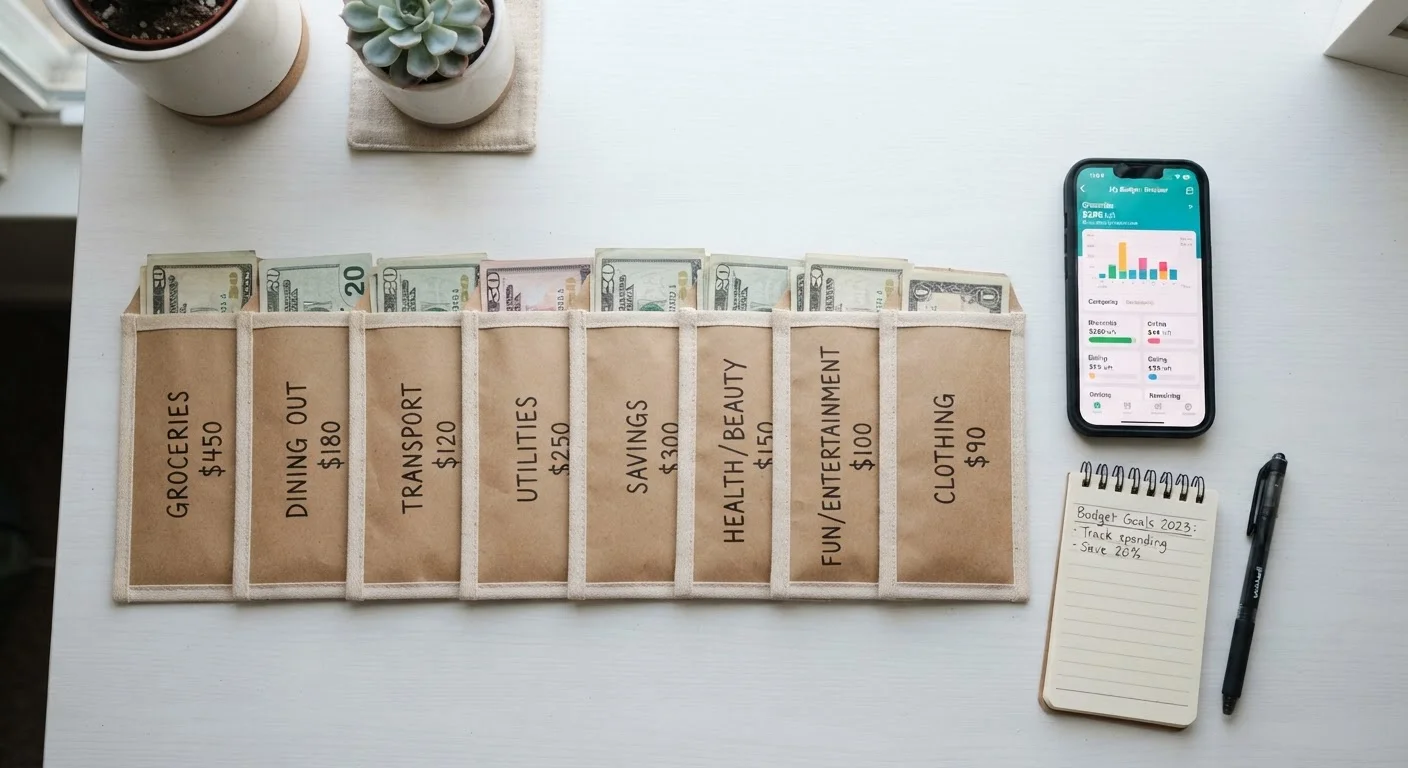
Photo credit: PrimeReads.net | Discover Insightful And Creative Blogs
In this article
Cash envelopes and digital tracking apps represent two different philosophies. Here's how they compare on flexibility, discipline, and day-to-day usability.
Key Takeaways
- Envelope budgeting uses physical cash to enforce hard spending limits by category.
- Digital trackers sync with bank accounts to log transactions automatically in real time.
- Envelope budgeting is more effective for impulse control; digital tools offer more flexibility and reporting.
- Neither method works without consistent follow-through - the best system is one you'll actually use.
- Many people successfully combine both approaches, using digital tools for tracking and envelopes for high-risk categories.
How Each System Works
Envelope budgeting is a cash-based method where you divide your monthly take-home income into labeled physical envelopes - one for groceries, one for gas, one for dining out, and so on. You spend only what's in each envelope. Once it's gone, that category is closed until next month. The system traces back decades and gained mainstream attention through financial educators who champion zero-based budgeting principles. For a broader look at how this fits into your overall financial picture, see Personal Budgeting from the Ground Up.
Digital spending trackers take a different path. These apps - available on smartphones and browsers - connect to your bank accounts and credit cards via secure integrations, then automatically categorize each transaction. Instead of setting aside physical cash, you set virtual spending limits and receive alerts when you approach or exceed them. The appeal is convenience: your entire financial picture updates automatically, with little manual input required.
Both systems follow the same underlying logic - give every dollar a job, track where it goes - but the mechanics and the psychology are quite different.
Side-by-Side Comparison
Understanding how these two approaches stack up across practical criteria helps clarify which fits your lifestyle. Consider each factor carefully before committing to one method - or a hybrid of both.
| Criterion | Envelope Budgeting | Digital Spending Trackers |
|---|---|---|
| Core mechanism | Physical cash divided by category | Automated transaction syncing |
| Spending enforcement | Hard stop - empty envelope ends spending | Soft alerts - you choose whether to act |
| Setup effort | Withdraw and sort cash monthly | Connect accounts; configure categories |
| Ongoing maintenance | Manual cash counting and logging | Mostly automated; occasional corrections |
| Works with cashless spending | Limited - cash-only by design | Yes - built for card and online transactions |
| Spending reports and trends | None built in | Charts, history, and category breakdowns |
| Risk of loss | Cash can be lost or stolen | Data-based; no physical loss risk |
| Best psychological fit | Tactile learners; impulse spenders | Data-oriented; mostly cashless users |
For a related angle on rigid versus flexible structures, The Case For and Against Strict Spending Limits offers a balanced perspective worth reading alongside this comparison.
Strengths and Limitations of Each Approach
Envelope budgeting excels at impulse control. Research in behavioral economics consistently shows that paying with cash feels more painful than swiping a card - a phenomenon sometimes called the "pain of paying." That friction is a feature, not a bug. The system also requires no technology and works without an internet connection, making it accessible to anyone.
Its limitations are real, though. Carrying cash is impractical for many modern transactions - online shopping, subscription services, and contactless payments don't fit neatly into a physical envelope. Tracking is also manual; you need to count cash and update records yourself. And if an envelope is lost or stolen, that money is gone.
Digital trackers shine on convenience and visibility. They remove the burden of manual logging and give you an accurate, up-to-date picture of spending without sorting receipts. Many platforms generate reports that help you spot patterns - like consistently overspending on takeout in the third week of every month - that would be hard to notice otherwise.
The downside is that digital alerts are easy to dismiss. Seeing a notification that you've hit 90% of your dining budget doesn't stop you the way an empty envelope does. There's also a learning curve with setup, and some people find the volume of data overwhelming rather than motivating. If you're curious how this digital-versus-paper tension plays out more broadly, Digital vs. Paper: Which Household Management System Actually Works? explores the trade-offs in depth.
Choosing What Works - or Combining Both
There's no universally superior option. The right system depends on your spending habits, your comfort with technology, and how your brain responds to visual and physical cues. If abstract numbers on a screen don't feel real enough to change your behavior, the tactile nature of cash may serve you better. If you rarely carry cash and do most spending digitally, forcing yourself into an envelope system may create more friction than benefit.
Many people find that a hybrid approach is the most sustainable: using a digital tracker as the primary system for visibility and record-keeping, while keeping one or two physical envelopes for categories where overspending is a known weakness. This captures the analytical power of digital tools without giving up the hard-stop discipline of cash for vulnerable categories.
Whatever you choose, consistency matters more than the tool itself. A simple system you use every week outperforms a sophisticated one you abandon by mid-month. If you'd like to explore other budgeting frameworks before deciding, Budgeting Approaches Compared covers zero-based, pay-yourself-first, and several other widely used strategies.
This article is for general informational and educational purposes only and does not constitute personalized financial advice. Consult a qualified financial professional for guidance tailored to your individual circumstances.

Author
Money Editorial Team
Money Editorial Team is the collective byline for our editorial team and contributor network. Articles published under this byline or an editorial pen name are researched, written, and reviewed according to our editorial standards for clarity, consistency, and independence before publication.
View all articles →