
The Tradeoffs of Optimising Every Hour of Your Day
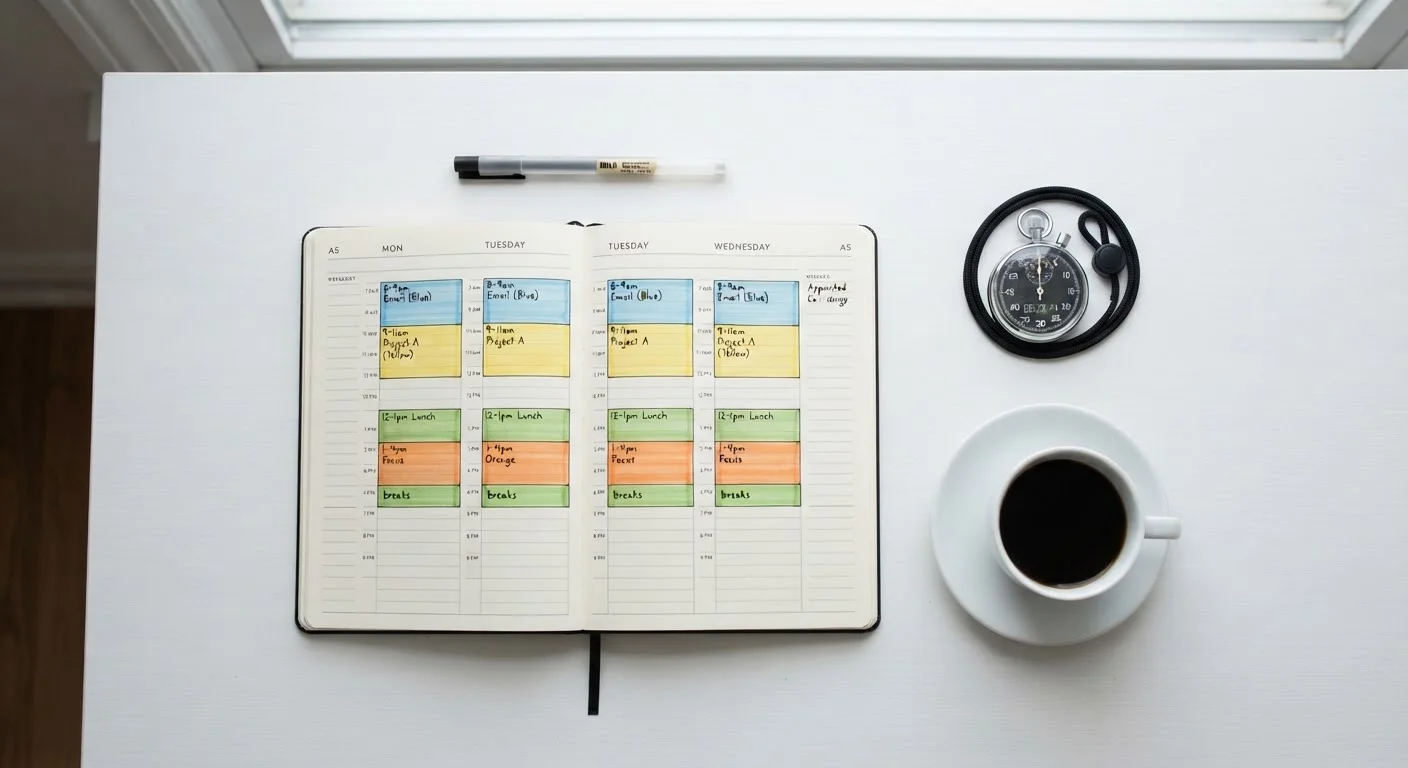
Photo credit: PrimeReads.net | Discover Insightful And Creative Blogs
In this article
Hyper-scheduling your day can boost output — but it comes with real costs. Here's an honest look at both sides of extreme routine optimisation.
Key Takeaways
- Optimising every hour can sharpen focus and reduce decision fatigue significantly.
- Rigid scheduling often struggles to absorb real-life disruptions without causing stress.
- The cognitive cost of maintaining a hyper-structured routine can erode creativity over time.
- A hybrid approach - structured core hours with flexible buffers - tends to be more sustainable.
- Your baseline energy patterns matter as much as how your hours are allocated.
Reduces daily decision fatigue
Pre-assigning tasks eliminates the recurring mental cost of deciding what to do next, freeing cognitive resources for the work itself.
Makes time use visible and honest
Mapping your day in advance exposes how long tasks actually take versus how long you assume they take, a gap most people underestimate.
Protects high-priority deep work
Blocking time for focused work makes it harder for lower-priority demands to crowd out what matters most.
Builds consistent habits faster
Recurring time blocks reinforce routines through repetition, which research on habit formation suggests accelerates automaticity.
Reduces procrastination on difficult tasks
A scheduled start time for a hard task lowers the psychological barrier to beginning, because the decision has already been made in advance.
Poorly absorbs real-life disruptions
When one block goes over time or an unexpected demand surfaces, a packed schedule has no room to flex without creating a cascade of delays.
Can suppress creative and spontaneous thinking
Unscheduled mental downtime plays a recognised role in insight and problem-solving; eliminating it may reduce the quality of non-linear work.
Increases anxiety around schedule breaks
People with hyper-optimised days often report heightened stress when plans deviate, attaching disproportionate weight to minor disruptions.
Difficult to sustain long-term
Maintaining a fully optimised schedule requires consistent motivation and ideal conditions - both of which fluctuate, making the system fragile over time.
Can reduce relationship and social flexibility
Tightly scheduled days can make spontaneous social engagement - a meaningful contributor to wellbeing - feel like a disruption rather than a benefit.
May ignore energy patterns in favour of time slots
Scheduling demanding tasks during low-energy periods because a slot is "available" undermines output and can increase fatigue.
What 'Optimising Every Hour' Actually Means
Hyper-scheduling - sometimes called time-blocking or extreme routine optimisation - means assigning a specific task or activity to every hour (or half-hour) of your waking day. Nothing is left to chance: deep work, email, meals, exercise, even leisure get a designated slot.
It's a popular approach among high performers and productivity advocates, and for good reason. But before overhauling your schedule around it, it's worth understanding both what you gain and what you give up. If you're not sure where your current routine stands, a structured daily audit is a useful first step.
The Real Advantages of a Tightly Structured Day
The case for optimising your schedule is solid when the conditions are right.
Reduces daily decision fatigue
Pre-assigning tasks eliminates the recurring mental cost of deciding what to do next, freeing cognitive resources for the work itself.
Makes time use visible and honest
Mapping your day in advance exposes how long tasks actually take versus how long you assume they take, a gap most people underestimate.
Protects high-priority deep work
Blocking time for focused work makes it harder for lower-priority demands to crowd out what matters most.
Builds consistent habits faster
Recurring time blocks reinforce routines through repetition, which research on habit formation suggests accelerates automaticity.
Reduces procrastination on difficult tasks
A scheduled start time for a hard task lowers the psychological barrier to beginning, because the decision has already been made in advance.
Research in behavioral science consistently shows that pre-committed plans reduce the friction of starting tasks, which is often where time gets lost. When the next action is already decided, you spend less mental energy negotiating with yourself about what to do next. For people managing complex projects or multiple responsibilities, that clarity has compounding value across a week.
Structure also creates an honest accounting of time. Many people dramatically underestimate how long tasks take or how much unstructured time quietly disappears. A mapped day makes that visible.
The Costs That Don't Show Up on Your Calendar
The downsides of extreme optimisation are less obvious but worth taking seriously.
Poorly absorbs real-life disruptions
When one block goes over time or an unexpected demand surfaces, a packed schedule has no room to flex without creating a cascade of delays.
Can suppress creative and spontaneous thinking
Unscheduled mental downtime plays a recognised role in insight and problem-solving; eliminating it may reduce the quality of non-linear work.
Increases anxiety around schedule breaks
People with hyper-optimised days often report heightened stress when plans deviate, attaching disproportionate weight to minor disruptions.
Difficult to sustain long-term
Maintaining a fully optimised schedule requires consistent motivation and ideal conditions - both of which fluctuate, making the system fragile over time.
Can reduce relationship and social flexibility
Tightly scheduled days can make spontaneous social engagement - a meaningful contributor to wellbeing - feel like a disruption rather than a benefit.
May ignore energy patterns in favour of time slots
Scheduling demanding tasks during low-energy periods because a slot is "available" undermines output and can increase fatigue.
The most underappreciated cost is what happens when the schedule breaks - and it will. A meeting runs long, a child gets sick, or an urgent task surfaces. In a loosely structured day, that's an inconvenience. In a hyper-optimised one, it can feel like a cascade failure, triggering stress disproportionate to the actual disruption.
There's also a creativity cost. Unstructured time - what researchers sometimes call "mind-wandering" - plays a genuine role in insight and problem-solving. Scheduling every hour can inadvertently cut off the mental space where non-linear thinking happens. This is one reason energy management rather than pure time management often produces more sustainable output.
~2 hrs
Average productive deep work per day for most people
Researchers studying knowledge workers, including Cal Newport's synthesis of earlier studies on deliberate practice, suggest most people have a limited daily capacity for intense focused work regardless of scheduling.
40%
Time lost to task-switching and unplanned interruptions
Estimates from workplace productivity researchers suggest roughly 40% of productive time is lost to interruptions and context-switching in typical knowledge work environments.
When Optimisation Helps vs. When It Hurts
Context matters enormously. Hyper-scheduling tends to work well during defined high-stakes periods: a product launch, exam revision, or a major project deadline. It's less well-suited as a permanent lifestyle, particularly for people whose work requires creative flexibility or whose daily environment is unpredictable.
Role and temperament also factor in. Different time management methods suit different work styles - what works for a software engineer with deep focus blocks may be counterproductive for a manager whose value lies in responsiveness and adaptive thinking.
If you notice your structured routine is causing anxiety rather than relieving it, that's a signal worth heeding. Pushing through that discomfort rarely fixes the underlying problem.
This Is General Productivity Guidance
The strategies discussed here are general approaches to time and routine management, not prescriptions for any individual situation. If structured routines are contributing to anxiety, chronic stress, or avoidance of rest, speaking with a qualified mental health professional is worthwhile. General productivity advice is not a substitute for personalised support.
A More Sustainable Middle Ground
The most durable approach for most people isn't full optimisation or full flexibility - it's a structured core with deliberate buffers. Anchor your most important work to fixed, protected time blocks, then leave 20-30% of your schedule genuinely unscheduled.
Those buffer zones absorb real-life disruption without derailing your day, and they create the mental space for reflection and creative thinking that rigid schedules eliminate. Comparing fixed and flexible approaches in more detail can help you find the right ratio for your situation.
The goal isn't to fill every hour - it's to ensure the hours that matter most are protected.

Author
Living Editorial Team
Living Editorial Team is the collective byline for our editorial team and contributor network. Articles published under this byline or an editorial pen name are researched, written, and reviewed according to our editorial standards for clarity, consistency, and independence before publication.
View all articles →