
Fixed Schedule vs. Flexible Routines: Which Works Better for Productivity?
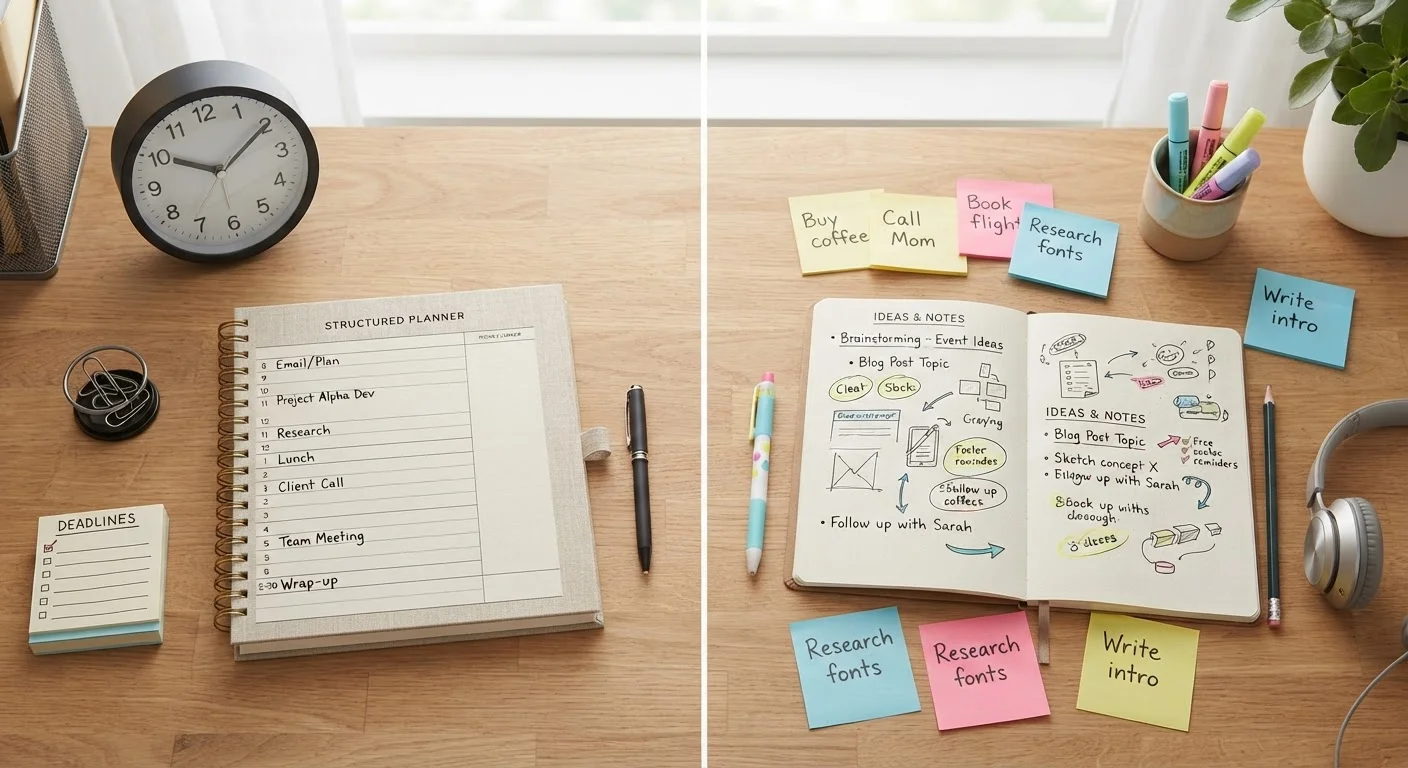
Photo credit: PrimeReads.net | Discover Insightful And Creative Blogs
In this article
Rigid schedules offer predictability; flexible routines offer adaptability. Weigh both approaches to find what fits your life and work style.
Key Takeaways
- Fixed schedules reduce decision fatigue and create predictable momentum for deep work.
- Flexible routines adapt better to unpredictable demands but require stronger self-discipline.
- Most people benefit from a hybrid approach anchored by a few non-negotiable time blocks.
- Your work type, energy patterns, and life demands should drive the choice - not productivity trends.
- Neither approach works without deliberate design and periodic review.
What Each Approach Actually Means
A fixed schedule assigns specific tasks or categories of work to locked time slots - the same blocks repeat daily or weekly regardless of circumstance. Think: email from 8-8:30 a.m., deep work from 9-11 a.m., meetings after lunch. The structure is largely non-negotiable.
A flexible routine works differently. Instead of assigning tasks to exact times, it establishes recurring behaviors - writing before screens, exercising before dinner - while leaving when those behaviors happen open to daily conditions. The sequence or priority may be fixed; the clock time is not.
Neither is the same as having no system at all. Flexibility without any anchoring principles quickly becomes improvisation, which research on self-regulation consistently links to lower follow-through. The real comparison is structured rigidity versus structured adaptability. For a broader look at how different systems compare, see how major time management approaches stack up.
The Case for Fixed Schedules
The core advantage of a fixed schedule is that it outsources daily decisions to the system itself. When 9 a.m. means deep work - always - there's no deliberation about whether to start, what to do first, or whether today warrants an exception. That reduction in decision fatigue is meaningful: willpower and decision-making share cognitive resources, and conserving them early in the day tends to improve output quality.
Fixed schedules also create accountability signals. Missing a time block is visible and concrete, making it easier to diagnose where a week went wrong. For people building new habits, this visibility matters - you're tracking behavior against a clear standard rather than a vague intention.
The limitation is brittleness. An unexpected meeting, a sick child, or a project emergency can collapse the day's architecture, and rigid schedulers sometimes struggle to recover or adapt mid-stream. Over-optimization of every hour carries its own costs - something explored in depth in the tradeoffs of hyper-scheduling your day.
| Fixed Schedule | Flexible Routine | |
|---|---|---|
| Decision fatigue | Low - structure decides | Higher - daily judgment required |
| Adaptability to disruption | Low - breaks down easily | High - designed for variability |
| Habit formation speed | Faster - consistent cues help | Slower - less automatic |
| Best work type | Deep, predictable tasks | Variable, reactive tasks |
| Risk of drift | Low - visible missed blocks | Higher - erosion is subtle |
| Self-discipline required | Moderate - system does work | High - self-managed daily |
The Case for Flexible Routines
Flexible routines excel when work volume, context, or energy fluctuates significantly day to day. Caregivers, freelancers, and managers whose calendars shift constantly often find that rigid time blocks create more frustration than focus - they spend energy protecting time slots rather than using them.
A behavior-anchored routine sidesteps this by tying tasks to triggers rather than clocks. "I write for 45 minutes before checking messages" works whether that writing starts at 7 a.m. or 10 a.m., making it more resilient to schedule disruption. Research on habit formation suggests that consistent behavioral sequences - doing X before Y - can be as effective as time-based scheduling for building automaticity.
The risk is drift. Without the visible structure of a calendar, flexible routines can quietly erode - tasks get deprioritized, sequences break down, and what started as adaptability becomes avoidance. This is why honest self-assessment is essential before choosing this approach. If you're unsure where your current routine is working or failing, a daily routine audit is a useful starting point before committing to any new system.
How to Choose - and How to Combine Both
Rather than treating this as binary, consider anchoring your day with two or three fixed time blocks around your peak energy windows, and leaving the rest flexible. Most people have identifiable windows - often mid-morning - when focus and cognitive performance are strongest. Protecting those slots with hard commitments while leaving surrounding hours more fluid captures the benefits of both approaches.
A few questions worth working through before deciding:
- How predictable is your calendar? If meetings and requests arrive unpredictably, fixed blocks will be disrupted constantly - flexibility becomes necessary, not optional.
- Are you building new habits or maintaining established ones? New habits generally benefit from fixed cues and times; established habits are more portable.
- Where do you lose the most time? If you lose time to indecision and task-switching, more structure helps. If you lose it to rigidity and failed recovery, more flexibility does.
It's also worth examining whether your current habits - however structured - are genuinely serving your output. Some well-intentioned routines quietly undermine productivity; common professional habits that reduce focus and efficiency is worth reviewing once you've settled on a framework. And once you've found a system that works, the goal shifts to longevity - see evidence-backed principles for routines that last for what separates durable systems from ones that fade within weeks.

Author
Living Editorial Team
Living Editorial Team is the collective byline for our editorial team and contributor network. Articles published under this byline or an editorial pen name are researched, written, and reviewed according to our editorial standards for clarity, consistency, and independence before publication.
View all articles →