
The Muscle Groups Every Exercise Routine Should Cover
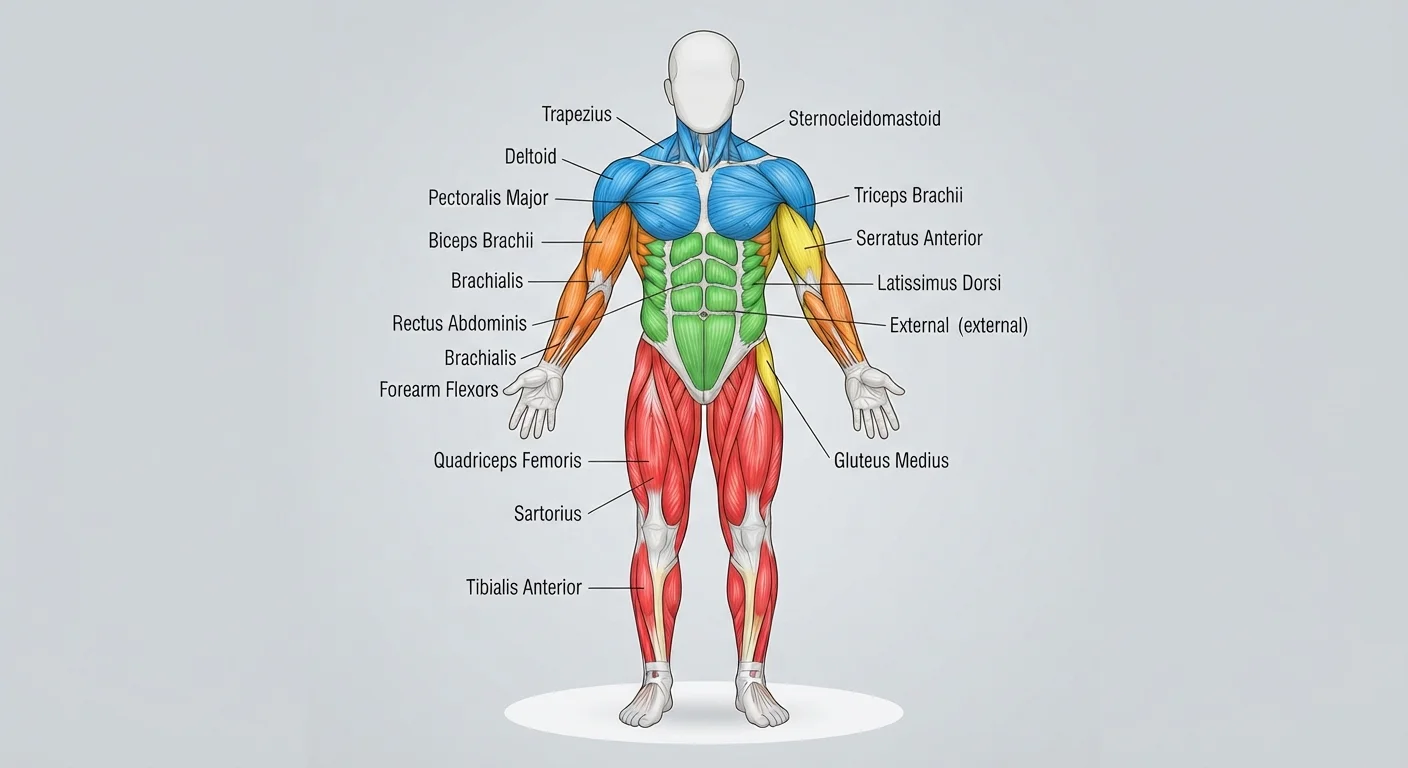
Photo credit: PrimeReads.net | Discover Insightful And Creative Blogs
In this article
A reference guide to the body's primary muscle groups, how each functions, and why balanced training across all of them matters.
Why Muscle Balance Matters
Most people gravitate toward exercises they enjoy or that target areas they want to look stronger. The result is a routine that overworks some muscles and leaves others undertrained. Over time, this imbalance can contribute to poor posture, joint strain, and a higher risk of injury during everyday movement and sport.
A well-designed exercise program distributes work across the body's primary muscle groups - not just the chest or biceps. Understanding what each group does, and why it needs training, helps you build a more complete and sustainable routine. See our guide to common beginner missteps for patterns to avoid when starting out.
Compound Movement
An exercise that involves more than one joint and recruits multiple muscle groups simultaneously. Examples include squats, deadlifts, and bench presses. They are generally more efficient than isolation exercises for building overall strength.
Isolation Exercise
An exercise that targets a single muscle group by moving through one joint only. Bicep curls and leg extensions are common examples. Useful for addressing specific weaknesses but less efficient as a standalone approach.
Antagonist Muscle
A muscle that performs the opposite action of the primary working muscle (the agonist). The biceps and triceps are antagonists to each other. Training antagonist pairs in balance reduces injury risk and supports joint health.
Training Volume
The total amount of work performed for a muscle group, typically calculated as sets multiplied by repetitions. Sufficient and balanced volume across all muscle groups is a core principle of well-rounded resistance training.
Core
The group of muscles that stabilize and move the trunk, including the abdominals, obliques, lower-back muscles, and pelvic floor. The core acts as a transfer station for force between the upper and lower body during nearly all physical activity.
The Primary Muscle Groups at a Glance
The human body contains more than 600 muscles, but exercise science typically organizes them into functional groups based on anatomical location and movement role. Here are the main ones every routine should address:
- Chest (Pectorals): Drive pushing movements - pressing a door open, pushing a stroller, or performing a push-up. Neglecting them limits upper-body pressing strength and shoulder stability.
- Back (Latissimus Dorsi, Rhomboids, Trapezius): Power pulling movements and stabilize the spine. Strong back muscles counterbalance the chest and are essential for posture. This group is commonly undertrained compared to the chest.
- Shoulders (Deltoids): Enable overhead reaching and lifting. They work alongside the chest and back in almost every upper-body movement and are critical for shoulder joint health.
- Core (Rectus Abdominis, Obliques, Transverse Abdominis, Erector Spinae): The core is not just the front of the abdomen - it encircles the torso. It transfers force between the upper and lower body and protects the spine during virtually all movement.
- Arms (Biceps, Triceps, Forearms): Assist elbow flexion and extension. While they're rarely the limiting factor in compound movements, targeted work supports grip strength and elbow joint integrity.
- Quadriceps: Located at the front of the thigh, these muscles extend the knee and are the primary driver in squatting and stair-climbing movements.
- Hamstrings: Run along the back of the thigh and flex the knee while extending the hip. They're among the most commonly injured muscles in active adults, often due to weakness relative to the quadriceps.
- Glutes (Gluteus Maximus, Medius, Minimus): The largest muscles in the body, responsible for hip extension, abduction, and rotation. Weak glutes are frequently linked to lower-back pain and knee tracking problems.
- Calves (Gastrocnemius, Soleus): Support ankle movement and absorb force during walking and running. Often overlooked in routine design.
| Number of skeletal muscles in the body | More than 600 (Gray's Anatomy, standard anatomical reference) |
| Primary muscle groups targeted in most programs | 9 (chest, back, shoulders, core, arms, quads, hamstrings, glutes, calves) |
| Most commonly injured muscle group in active adults | Hamstrings (Broadly reported in sports medicine literature) |
| Largest muscle in the human body | Gluteus maximus (Standard anatomical consensus) |
| Recommended resistance training frequency (general adults) | 2-4 sessions per week (American College of Sports Medicine guidelines) |
Training Principles for Full-Body Coverage
Covering all major muscle groups doesn't require exercising every day. Many effective programs use a push/pull/legs split or a full-body approach performed two to four times per week. The key principle is that opposing muscle groups - such as chest and back, or quadriceps and hamstrings - should receive roughly equivalent training volume to maintain balance.
Compound movements (those that cross more than one joint) are especially efficient because they recruit multiple muscle groups simultaneously. Squats, deadlifts, rows, and overhead presses each engage several groups at once, making it easier to achieve full-body coverage within a reasonable time commitment.
That said, no routine is complete without rest. Muscle tissue repairs and strengthens during recovery, not during the workout itself. For more on why recovery is as important as the session itself, see our article on sleep and physical recovery. And for guidance on pairing resistance work with aerobic activity, our cardio and strength training overview explains how the two interact.
Exercise needs also shift over the decades. What constitutes balanced training in your 30s differs meaningfully from what's appropriate at 60. Our guide on exercise across the lifespan covers how to adapt as your body changes.
This article is for general informational purposes only and does not constitute medical or fitness advice. Consult a qualified healthcare provider or certified fitness professional before beginning or modifying any exercise program, especially if you have an existing health condition or injury.

Author
Health Editorial Team
Health Editorial Team is the collective byline for our editorial team and contributor network. Articles published under this byline or an editorial pen name are researched, written, and reviewed according to our editorial standards for clarity, consistency, and independence before publication.
View all articles →