
The Science Behind Habit Loops and How to Use Them Deliberately
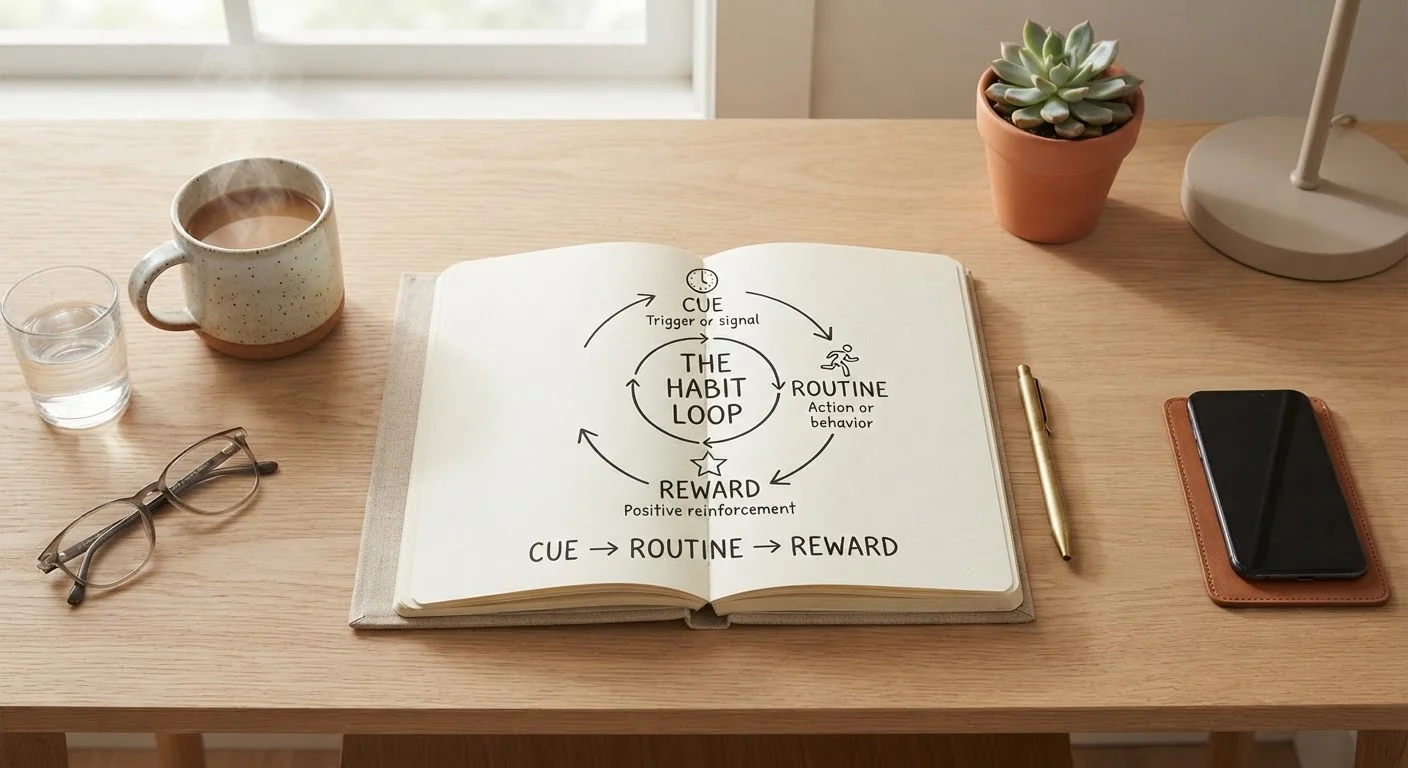
Photo credit: PrimeReads.net | Discover Insightful And Creative Blogs
In this article
Habit loops — cue, routine, reward — explain why behaviours stick. Learn how to use this framework to build lasting productive habits.
Key Takeaways
- Every habit follows a cue-routine-reward loop that your brain automates over time.
- You can't simply erase a habit - but you can rewire it by keeping the cue and reward while swapping the routine.
- Stacking a new habit onto an existing one is one of the most reliable ways to make it stick.
- Vague intentions rarely produce lasting habits; specific cues and immediate rewards do.
- Consistency over a few weeks - not a single day - is what moves a behaviour toward automaticity.
What the Habit Loop Actually Is
The habit loop framework - popularised in academic literature and later in mainstream discussions of behaviour change - describes the cycle your brain runs through every time it executes an automatic behaviour. It has three components:
- Cue: A trigger that tells your brain to initiate a behaviour. This can be a time of day, a location, an emotion, another behaviour, or even a specific person.
- Routine: The behaviour itself - physical, mental, or emotional.
- Reward: The positive outcome that signals to your brain that this loop is worth remembering.
Each time the loop completes, the neural pathway supporting it gets marginally stronger. Over many repetitions, the sequence becomes increasingly automatic - requiring less conscious effort and less willpower to execute. This is why you can brush your teeth on autopilot while thinking about something else entirely.
The same mechanism that makes helpful habits effortless also makes harmful ones persistent. Understanding that both operate through identical circuitry is what makes the framework so practically useful.
Using the Loop to Build New Habits
Building a habit deliberately means engineering all three elements of the loop before the behaviour has become automatic. Most people skip this step - they decide to start a new behaviour but leave the cue and reward undefined, which is why most habits fail in the first two weeks.
Start with the cue, not the motivation
Most people try to build habits by boosting their motivation - telling themselves they'll "want to" do the behaviour more. A more reliable approach is to design the cue first. Decide exactly when and where the routine will happen, link it to something already in your day, and let repetition do the motivational work over time.
Design your cue first. A strong cue is specific and consistent. "I'll exercise" is not a cue. "When I hear my 7 a.m. alarm, I put on my running shoes" is. Specificity matters because vague intentions require ongoing decision-making, which depletes the mental energy you need for the behaviour itself.
Habit stacking is one of the most reliable cue strategies available: attach your new behaviour to an already-automatic one. For example, if you want to build a brief mindfulness practice, doing it immediately after an existing anchor habit - say, brewing your morning coffee - gives you a ready-made trigger every day.
Make the reward immediate. Long-term payoffs like better health or higher productivity are too abstract to drive early habit formation reliably. Pairing the new routine with an immediate, genuine positive - a moment of satisfaction, a brief pleasure, a quick acknowledgment of completion - gives the brain the signal it needs. Over time, the behaviour itself can become intrinsically rewarding, but you usually need to bridge that gap at the start.
This same framework applies across many life domains. Whether you're building consistent healthy eating patterns or establishing a preventive health routine, the underlying loop structure is the same - what changes is the cue and the reward you choose to anchor it.
Rewiring Existing Habits
Because the basal ganglia retains the memory of a habit even after long periods of disuse, trying to simply stop an unwanted behaviour is rarely effective on its own. A more durable approach is to keep the cue and reward intact but substitute a different routine in between.
If the cue is stress and the reward is relief, replacing scrolling on your phone with a five-minute walk can satisfy the same underlying need while changing the behaviour. The key is correctly identifying what the reward actually is - sometimes it's not what it appears to be at first glance. Tracking your pattern for a few days before intervening tends to produce more accurate insight into what's really driving the loop.
For habits involving your physical environment - like keeping your home organized - the same principle applies. The cues you build into your space (keys always hung by the door, items returning to designated spots) create passive prompts that make the routine more likely. See how this plays out in practice in long-term home organization habits.
Making Habit Loops Work Across Your Whole Routine
Individual habits don't exist in isolation - they interact with and reinforce each other. A morning routine is essentially a chain of interlocking habit loops, each cuing the next. Designing that chain consciously, rather than letting it form by default, gives you far more control over how your days actually unfold.
One structural habit worth considering is a regular weekly review practice. This functions as a meta-habit: a recurring loop that keeps your other habits visible and adjustable. Its cue might be Sunday evening; its routine might be fifteen minutes of reflection and planning; its reward, the clarity of heading into a new week with intention.
The broader principles of what makes routines last - not just days or weeks but months - are worth understanding alongside the habit loop model. Evidence-backed routine design principles can help you sequence and structure habits in a way that supports each other rather than competing for attention or willpower.
The habit loop won't guarantee results, and no framework removes the need for consistent effort - especially early on. But it does give you a concrete, research-grounded model to work from rather than relying on motivation alone, which is notoriously unreliable as a long-term strategy.
This article is for general informational and educational purposes only. It does not constitute medical or psychological advice. If you have concerns about your mental health or behaviour, consult a qualified healthcare professional.
Frequently Asked Questions

Author
Living Editorial Team
Living Editorial Team is the collective byline for our editorial team and contributor network. Articles published under this byline or an editorial pen name are researched, written, and reviewed according to our editorial standards for clarity, consistency, and independence before publication.
View all articles →