
The Difference Between a Lateral Move and a Step Backward
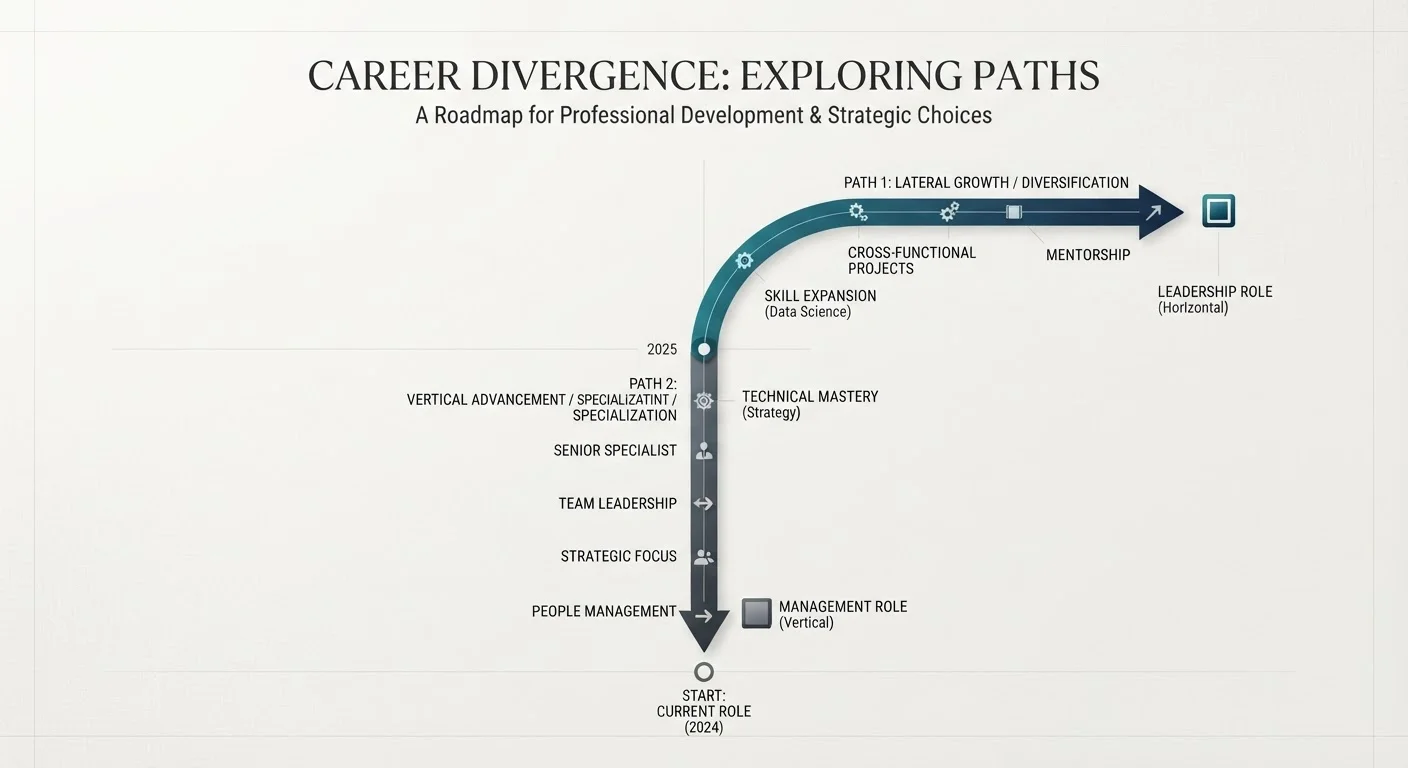
Photo credit: PrimeReads.net | Discover Insightful And Creative Blogs
In this article
Not every sideways career move is a demotion. Learn how to tell a strategic lateral shift from an actual setback.
Key Takeaways
- A lateral move can be a deliberate, growth-oriented decision - not a consolation prize.
- The defining factor is whether the move builds leverage for future advancement or simply reduces it.
- Compensation, title, and scope of responsibility are the three clearest signals to evaluate.
- Context matters: a move that looks like a step back externally can be a strategic gain internally.
- Framing a lateral move well on a resume or in interviews prevents it from reading as a setback to others.
Why the Distinction Matters
Career advice often treats "moving up" as the only valid form of progress, which creates a distorted lens through which people evaluate their options. When a promotion isn't on the table, many professionals assume any other move is a concession - a sign that their career is stalling. That assumption is worth questioning.
The practical difference between a lateral move and a step backward lies in what the move does to your professional leverage: your skills, your network, your options, and your earning trajectory over time. A lateral move can strengthen all four. A genuine step backward tends to erode at least one without compensating elsewhere.
Understanding this distinction matters for two reasons. First, it helps you evaluate opportunities more clearly when you're weighing your own options. Second, it shapes how you communicate your career history to future employers. See our breakdown of common career growth myths for more on how assumptions can distort good decision-making.
What Makes a Lateral Move Strategic
A lateral move is strategic when it is made with intent - when you can articulate what you're gaining and how it connects to a longer-term goal. Common legitimate reasons to move laterally include:
- Skill acquisition: Moving into a role that exposes you to a function you've lacked, such as a marketing manager shifting into a product role to understand the full business lifecycle.
- Industry repositioning: Accepting an equivalent-level role in a higher-growth sector where your current skills are more valued or better compensated over time.
- Network expansion: Joining a larger or more strategically connected organization at the same level to widen your professional reach.
- Escape from a ceiling: Moving out of a team or company where upward mobility is structurally blocked, even if the new role doesn't come with an immediate title upgrade.
In each of these scenarios, something tangible is gained - a capability, a position in the market, or access that didn't exist before. That's the hallmark of a lateral move as opposed to a drift backward. For a deeper look at how to frame these transitions when changing fields, see our guide on reframing your experience for a new field.
Test the Move Against Your Five-Year Goal
Before accepting any lateral role, write out a one-paragraph answer to this question: "How does this role help me get to where I want to be in five years?" If you can't write a convincing answer, that's a meaningful signal worth sitting with before you decide. A strong lateral move should have a clear - if not guaranteed - forward connection.
The Three Signals That Indicate a Step Backward
Not every move framed as a "learning opportunity" or "fresh start" is a strategic lateral shift. There are three concrete signals that a move may actually be a step backward:
- Reduced scope without a compensating gain: If you're managing fewer people, a smaller budget, or a narrower function - and gaining no new skills, access, or earning potential in return - your professional footprint is shrinking.
- Lower compensation with no credible path to recovery: A pay cut can be justified if the new role positions you for significantly higher earnings within a reasonable horizon. If no such path exists and the reduction is simply a loss, that's a backward move financially.
- Fewer future options: The clearest test is counterfactual: will this role make your next opportunity better or worse? If the honest answer is "worse" - because it narrows your perceived expertise or puts you in a lower-visibility environment - it's likely a step back.
These signals don't make a backward move categorically wrong. Sometimes life circumstances - health, caregiving, burnout recovery - justify accepting a reduced role temporarily. The key is making that decision with clear eyes rather than rationalizing a loss as a gain.
How to Evaluate a Move Before You Make It
When assessing whether an opportunity is lateral or backward, work through these questions deliberately:
1 in 3
Workers who make a lateral move before their next promotion
Research from organizational behavior studies suggests horizontal mobility often precedes upward advancement, particularly in larger organizations with complex structures.
~60%
Mid-career professionals who report making at least one lateral move
Workforce surveys consistently find lateral moves are a normal part of mid-career development, not an exception, according to career research published by labor economists.
- What specific capability or access does this role provide that I don't currently have?
- Is my compensation staying within an acceptable range - or am I accepting a meaningful reduction without a credible upside?
- In 18 to 24 months, will this role make me more or less competitive for the position I ultimately want?
- Am I moving toward something, or primarily moving away from something uncomfortable?
That last question is particularly revealing. A move driven by avoidance - escaping a bad manager, a toxic culture, or job insecurity - can still be lateral if it lands you in a better environment at equivalent standing. But if the primary motivation is escape and the destination isn't clearly better for your trajectory, you may be trading one problem for a new limitation.
For a broader framework on how advancement decisions play out over a career, the working guide to career growth across every stage covers how the logic of career moves shifts at different points in a professional life.
Framing a Lateral Move So It Doesn't Read as a Setback
Even a well-considered lateral move can raise questions from future hiring managers if it isn't explained with clarity. The goal is to demonstrate that the move was chosen, not suffered. A few principles help:
- Lead with intent: On a resume and in interviews, be explicit about what you were seeking when you made the move. Vague explanations invite skeptical interpretations.
- Anchor to outcomes: Describe what you accomplished or learned in the lateral role, not just that you held it. Results reframe the narrative from stagnation to development.
- Connect the dots forward: Show how the lateral role connects to the position you're now pursuing. A logical throughline - even across a non-linear path - reads as deliberate career architecture, not a gap.
Professionals who change industries will find this framing especially important. See our related piece on career pivots that stick for guidance on how to build and communicate a credible narrative across a shift in sector or function.
Ultimately, the difference between a lateral move and a step backward is less about the title on the org chart and more about the trajectory it supports. A clear-eyed evaluation - before and after the move - is what separates deliberate career navigation from drift.
Frequently Asked Questions

Author
Career Editorial Team
Career Editorial Team is the collective byline for our editorial team and contributor network. Articles published under this byline or an editorial pen name are researched, written, and reviewed according to our editorial standards for clarity, consistency, and independence before publication.
View all articles →