
Generalist vs. Specialist: Which Career Path Builds More Long-Term Value?
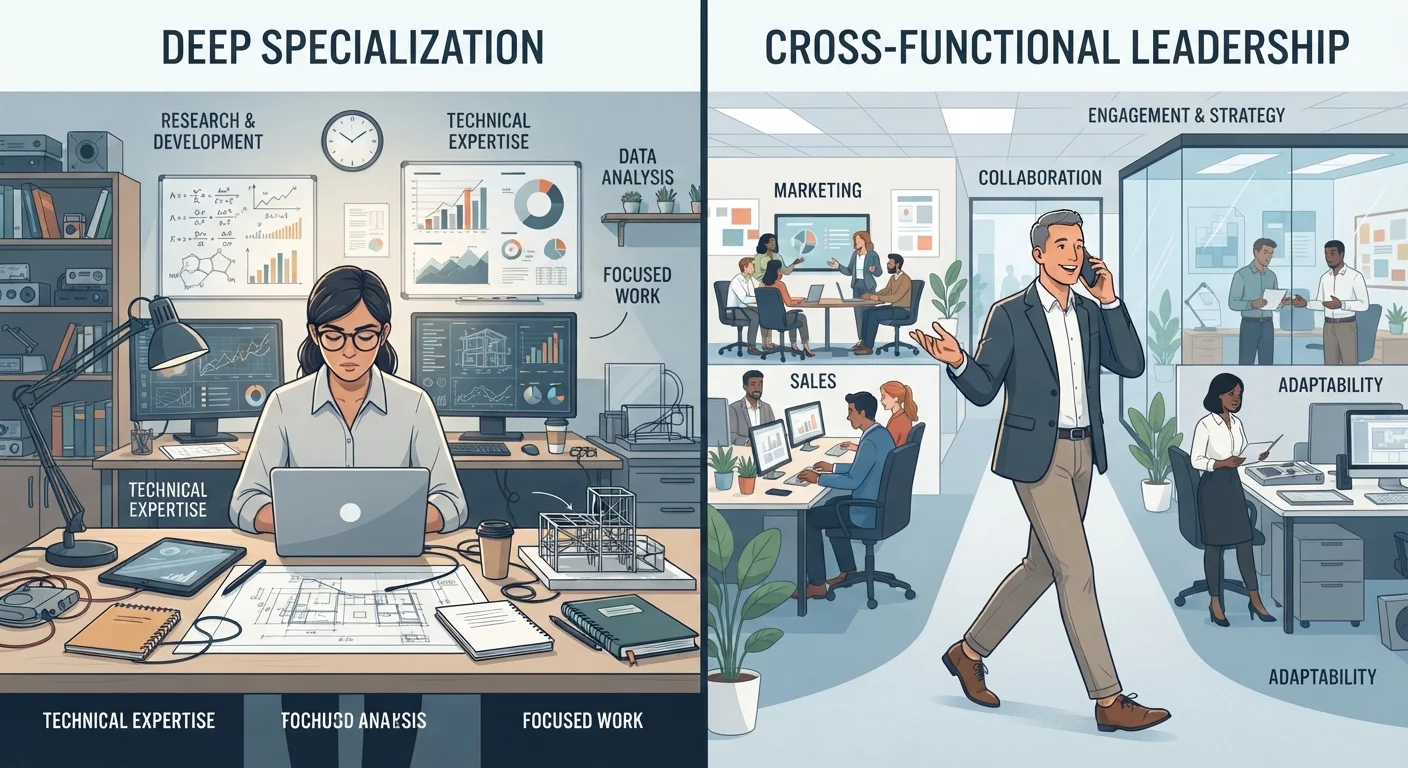
Photo credit: PrimeReads.net | Discover Insightful And Creative Blogs
In this article
Should you go broad or deep in your expertise? A clear look at how each path plays out across industries and career stages.
Key Takeaways
- Generalists adapt well across roles and industries, making them strong candidates for management and leadership positions.
- Specialists command premium compensation in high-demand technical fields but face greater risk if their niche contracts.
- Career stage matters: early breadth often enables later specialization without closing doors prematurely.
- The T-shaped professional model - broad knowledge plus one deep expertise - offers a practical middle ground.
- Industry context shapes which path delivers more long-term value; no single answer fits every field.
- Transitions between paths are possible with deliberate skills-bridging and narrative framing.
What Each Path Actually Means
The terms generalist and specialist are used loosely in career conversations, so it helps to define them precisely. A generalist develops competency across multiple domains - they can speak to marketing, operations, finance, and people management without being an authority in any single one. A specialist builds concentrated expertise in one discipline, technology, or methodology, often backed by credentials, certifications, or years of focused practice.
Neither label is fixed for life. Many professionals begin as generalists during their first five to seven years - rotating roles, absorbing organizational context, and building foundational workplace skills - before deliberately narrowing their focus. Others specialize early and deliberately broaden later to qualify for leadership roles. What matters is understanding the trade-offs at each stage so you can make intentional choices rather than drifting by default.
It's also worth noting that the myth that one path is universally superior persists in career culture. In practice, the better question is: which path fits your industry, career stage, and professional goals?
Where Each Path Builds Advantage
Generalists tend to outperform in roles that require integration - pulling together people, information, and resources across functions. This makes them natural candidates for general management, consulting, entrepreneurship, and cross-functional project leadership. Their broad exposure also creates resilience: when a single market or function contracts, a generalist's transferable skills remain in demand elsewhere.
Specialists, by contrast, build leverage through scarcity. When an organization needs a machine learning engineer, a regulatory affairs expert, or a cardiac imaging specialist, a deep practitioner commands both access and compensation that a generalist simply cannot replicate. In fields where the knowledge gap between an average practitioner and an expert is measurably large - and where that gap has real consequences - specialists hold significant market power.
| Criterion | Generalist | Specialist |
|---|---|---|
| Core strength | Adaptability, integration, coordination | Depth, authority, technical precision |
| Best career stage fit | Early career and senior leadership | Mid-career through expert practitioner |
| Compensation ceiling | High in management and executive roles | High in scarce, credentialed technical fields |
| Resilience to market shifts | Strong - transferable across industries | Varies - depends on niche demand durability |
| Advancement path | General management, operations, leadership | Principal, director of specialty, subject-matter expert |
| Career pivot ease | Easier - broad skills transfer readily | Harder - niche expertise may not translate |
| Industry fit | Startups, consulting, cross-functional orgs | Tech, healthcare, law, financial services |
Industry structure shapes which advantage is larger. In fast-moving sectors like technology startups, broad contributors who can wear multiple hats are often prized early. In established sectors like pharmaceuticals, defense contracting, or financial regulation, credentialed depth is frequently a non-negotiable hiring filter. Understanding your sector's talent economics is as important as understanding your own skills inventory. For a deeper look at how internal versus external moves interact with this dynamic, that framing applies here too.
The T-Shaped Model and How to Apply It
Career researchers and organizational strategists have increasingly pointed to a hybrid framework called the T-shaped professional. The horizontal bar of the T represents broad, working knowledge across disciplines - enough to collaborate, communicate, and coordinate effectively. The vertical bar represents genuine depth in one area - enough to lead, solve hard problems, and be recognized as a credible authority.
This model is pragmatic because it sidesteps the false binary. You don't choose between being a generalist or a specialist permanently; you choose where to invest your developmental energy at each career stage. Early career: build the horizontal bar. Mid-career: extend the vertical. Senior career: leverage both to lead multidisciplinary teams and solve complex organizational problems.
The T-Shape Isn't Fixed
Professionals can shift the shape of their T over time - deliberately broadening during a leadership transition or deepening when market signals show a specific skill becoming scarce and valuable. The key is intentionality: know which bar you're investing in and why, rather than letting the shape form by accident. Most career plateaus occur not because someone chose wrong, but because they stopped making active choices about their developmental direction.
If you're considering a shift - either deepening a specialty or expanding your range - the structural work involved in that transition deserves careful planning. The principles covered in career pivots that stick apply directly: skills-bridging, reframing your narrative, and timing the move relative to market conditions all determine whether the transition holds. Similarly, understanding how soft and hard skills interplay helps you identify which parts of your current profile transfer most readily.
Making the Decision That Fits You
Before defaulting to either path, ask three diagnostic questions. First: What does advancement look like in your specific field? In some industries, the senior ladder runs through technical mastery; in others, it runs through people leadership. Map that trajectory before assuming which direction to grow.
Second: Where is your genuine engagement strongest? Sustained depth requires genuine interest - specialists who plateau often do so because the domain stopped engaging them, not because the market dried up. Breadth, meanwhile, requires comfort with ambiguity and context-switching that not everyone finds energizing.
Third: What does your current skills profile signal to hiring managers? Review how your resume reads: does it tell a coherent story of developing expertise, or does it look scattered? A generalist background needs clear narrative framing to avoid reading as unfocused. A specialist background needs evidence of range - collaboration, communication, leadership moments - to avoid reading as narrow. The full arc of career growth strategies shifts at every stage, and the generalist-specialist question is one you'll revisit more than once across a long career.
68%
of executives started with generalist roles
A Korn Ferry analysis of C-suite career histories found that the majority of senior executives had held cross-functional roles before reaching the top level.
2x
salary premium for scarce specialists in tech
Labor market research from sources including the Bureau of Labor Statistics consistently shows that highly specialized roles in software and data science command significant pay premiums over generalist equivalents.
3-5 yrs
typical time to develop recognized domain expertise
Career development researchers generally estimate that meaningful, recognized specialization in most professional fields takes between three and five years of focused, deliberate practice.

Author
Career Editorial Team
Career Editorial Team is the collective byline for our editorial team and contributor network. Articles published under this byline or an editorial pen name are researched, written, and reviewed according to our editorial standards for clarity, consistency, and independence before publication.
View all articles →